Your healthcare Application journey starts here.


Blogs
DENTAL SCHOOL SUPPLEMENTAL ESSAYS: HOW TO ANSWER EVERY PROMPT EFFECTIVELY


TL;DR Summary:
Some dental schools require supplemental applications, additional information, or school-specific essays beyond the ADEA AADSAS primary application. Strong supplemental responses answer the exact prompt, reflect genuine research into the program, and connect your experiences and goals to that school's priorities. Reuse relevant experiences rather than identical answers, and verify all school-specific requirements directly with the program before submitting.
.png)
INTRODUCTION
You've submitted your ADEA AADSAS application. Now, depending on the schools you've applied to, you may begin receiving supplemental applications, additional requirements, or school-specific essay prompts.
Unlike your primary personal statement which you crafted carefully over months many applicants treat supplemental essays as an afterthought. Recycled or generic responses can make it harder to demonstrate genuine program fit.
Supplemental essays are your chance to demonstrate genuine interest in a specific school, address any gaps in your application, or clarify your long-term goals. But only if you approach them strategically.
In this guide, you'll learn how to interpret different supplemental prompts, avoid the most common mistakes that weaken applications, organize your essays by school and deadline, and craft responses that actually strengthen your candidacy. We'll also show you how to track everything systematically so you don't fall behind as secondary applications pile up.
What Are Dental School Supplemental Essays?
Dental school supplemental essays are school-specific writing prompts that some dental programs may require in addition to the ADEA AADSAS primary application. Supplemental requirements vary by school and may include essays, additional information, forms, fees, or other materials submitted directly to the program.
Unlike your primary personal statement, which goes to all schools, each program sends custom prompts tailored to their mission, curriculum, and admissions priorities. These supplemental essays may ask about your specific interest in their program, how you handle challenges, your clinical experiences, or your career goals.
Deadlines, response lengths, and submission requirements vary by school. Always follow the instructions provided by the individual dental program.
Understanding Supplemental Essays vs. Primary Essays
Your ADEA AADSAS primary application includes essays that all schools receive. Your personal statement ("Why do you want to be a dentist?") is standardized across programs.
Supplemental essays are different. They're school-specific, meaning each program writes its own prompts. School A might ask, "Why our program?" School B might ask about your experience with underserved communities. School C might ask how you handle failure.
This distinction matters because it affects your strategy:
| Aspect | Primary Essay | Supplemental Essay |
| Submission | Sent through ADEA AADSAS to your designated participating schools | Reaches only that specific program |
| Prompt Type | Standardized prompt | Program-specific prompt |
| Focus | Personal motivation | Program fit + personal alignment |
| Reach | Core application content is shared across designated schools | School-specific responses should address the individual program and prompt. |
| Purpose | Shows who you are | Can demonstrate school-specific fit where the prompt invites it |
Because supplemental prompts are school-specific, they give applicants an additional opportunity to demonstrate fit, provide context, and respond directly to a program's priorities.
What Dental Schools May Assess Through Supplemental Questions
Dental schools may use supplemental questions to:
1. To assess fit A school emphasizing rural health wants to know whether you care about rural service. Their supplemental prompt reveals applicants who actually share that mission versus those just applying everywhere.
2. To fill application gaps If your GPA dipped sophomore year, a program might ask about challenges you've overcome. Your primary essay might not address this. Supplementals give you space to explain.
3. To learn about your goals Schools want to understand what you specifically want to accomplish in dentistry. Do you see yourself as a clinician? A researcher? A community health advocate? Your supplemental answers show your depth and specificity.
When you understand why a school asks a question, you can answer more thoughtfully.
Common Supplemental Prompt Types (and How to Approach Each)
Most dental school supplementals fall into recognizable categories. Understanding the type helps you structure a stronger response.
1. "Why Our School?"
What they're asking: What specifically attracts you to this program? Why not another school?
Weak approach: "Your program is well-ranked and has great clinical facilities. Your faculty are excellent educators. I'm excited to potentially attend your school."
Why this fails: Could apply to any school. Uses only public information. Shows no research.
Stronger approach: "Your 10-week rural externship places students in three different community health centers, which aligns with my goal to practice in underserved areas. I'm particularly drawn to your partnership with [specific clinic] because I want to develop the population health perspective that your program emphasizes. Your emphasis on preventive care not just treatment shaped my decision to pursue dentistry."
Why this works: Specific program feature. Shows you researched partnerships. Connects program mission to your goals. Demonstrates knowledge of curriculum.
2. "Tell Us About a Challenge You've Overcome"
What they're asking: How do you handle adversity? What did you learn?
Weak approach: "In my junior year, I got a C in organic chemistry. I was sad but studied harder and got an A in the next class. This taught me resilience."
Why this fails: Generic narrative. Obvious lesson. Doesn't show growth or strategy.
Stronger approach: "Halfway through organic chemistry, my first major exam showed that I was struggling with mechanism-based questions about the conceptual foundation of the course. Rather than just studying more hours, I met with the course professor during office hours, learned that I was memorizing mechanisms instead of understanding them, and shifted my approach to building conceptual maps. When I retook the exam, I earned an A. This experience taught me that effort without strategy doesn't work in chemistry or dentistry. Now, when I encounter a clinical challenge, I pause to understand the root cause before I escalate."
Why this works: Specific situation. Shows actual problem-solving (identified root cause, changed strategy). Connects lesson to dentistry. Demonstrates self-awareness.
3. "What Does Dentistry Mean to You?" or "Why Dentistry?"
What they're asking: Do you have genuine motivation, or are you just interested in a stable career?
Weak approach: "Dentistry is a rewarding profession. Dentists help people every day. I want to make a difference and have a good job."
Why this fails: Could apply to most health professions. Generic benefits. Doesn't show real motivation.
Stronger approach: "During my community health internship, I saw a patient who hadn't seen a dentist in eight years return for her first appointment in months. Over three visits, she went from embarrassed and withdrawn about her smile to genuinely laughing in the waiting room. That transformation not just the clinical work, but the confidence restoration is why I want to practice dentistry. I realized that oral health is intertwined with mental health, career prospects, and dignity in ways I hadn't understood before."
Why this works: Specific experience. Shows impact beyond clinical skills. Demonstrates values (dignity, confidence). Reveals understanding of dentistry's broader role.
4. "How Would You Contribute to Our Community?"
What they're asking: What unique perspective or skills would you bring? How would you be involved?
Weak approach: "I would volunteer at the student-run dental clinic and participate in community outreach. I'm interested in serving underserved populations."
Why this fails: Standard answer. Every applicant says this. No specificity about how or what unique contribution.
Stronger approach: "As a first-generation college student, I understand the barriers underserved communities face in accessing care and navigating the healthcare system. I would leverage this perspective by working with your student-run clinic to develop patient-education materials in Spanish and English, informed by conversations with patients about their actual barriers not assumptions. I'd also be interested in your mentoring program because I want to encourage students from backgrounds similar to mine to pursue health professions."
Why this works: Reveals identity and perspective. Offers concrete contribution (materials development). Shows understanding of real barriers. Demonstrates commitment to mentoring/community.
5. "Describe a Clinical Experience"
What they're asking: How do you learn from hands-on work? What did you observe or do?
Weak approach: "I shadowed a dentist for 20 hours. I saw cleanings, fillings, and extractions. It was interesting and confirmed that I want to be a dentist."
Why this fails: Passive observation. No reflection. Doesn't show learning or depth.
Stronger approach: "During a four-week dental clinic experience, I observed patient care across a range of procedures. At first, I focused mainly on the clinical steps. Over time, I began noticing how the dentist's communication affected patients who were anxious before treatment. Watching her explain what to expect, pause for questions, and acknowledge patients' concerns showed me that effective dental care depends on communication as much as technical skill."
Why this works: Specific numbers/timeline. Shows progression (week 1 vs. week 4). Demonstrates observation and reflection. Connects experience to broader principle. Shows initiative (asked the dentist, applied learning).
6. "How Do You Stay Current in Dentistry?"
What they're asking: Do you understand that dentistry evolves? Will you pursue lifelong learning?
Weak approach: "I follow dental journals and read articles. I think continuing education is important for all dentists."
Why this fails: No specific evidence. Theoretical rather than demonstrated.
Stronger approach: "I subscribe to the Journal of Clinical Dentistry. After reading an article on laser-assisted periodontal therapy, I searched our school's clinical database to see how it compared to traditional methods and I was surprised by the outcomes. That one article shifted how I think about treatment planning. Now I try to apply that same approach to one new topic each month: find something interesting, dig into the evidence, and see how it changes my thinking."
Why this works: Specific evidence of ongoing learning. Shows how you stay current (journals, webinars, peer discussion). Demonstrates self-directed education. Shows adaptability.
Disclaimer: The examples above are fictional and intended to demonstrate structure and specificity. Applicants should use only their own experiences and truthful details.
Common Mistakes That Weaken Supplemental Essays
Mistake 1: Submitting Generic Answers Across Multiple Schools
Why it matters: Generic responses can make it harder to demonstrate genuine program fit and may make your application less distinctive.
What happens: A one-size-fits-all answer fails to address what makes each school unique its mission, clinical strengths, or educational philosophy. Schools notice when applicants haven't engaged with their specific program.
What to do instead: Even if two schools ask similar questions, tailor your answer. Reference specific programs, faculty, clinical opportunities, or values. If School A has a rural track and School B emphasizes research, your answer should reflect that difference.
Mistake 2: Focusing Only on School Rankings or Facilities
Why it matters: Admissions committees know their school's ranking. They don't need you to praise their reputation. They want to know whether you understand their philosophy and mission.
What happens: Your essay sounds like promotional copy for a hospital, not a genuine fit statement.
What to do instead: Research the school's strategic plan, dean's message, or program values. Look at curriculum emphases (rural health? digital dentistry? pediatric focus?). Reference specific courses, faculty research, or clinic partners. Show that you understand what makes this school different.
Mistake 3: Answering the Wrong Prompt or Misreading the Question
Why it matters: Each school designs its supplemental prompt to elicit specific information about fit, motivation, or clinical thinking. A prompt that asks "How do you handle failure?" is not the same as "Describe your greatest weakness." If you answer the wrong question, the reader immediately knows you didn't read carefully.
Still Managing Essays in Google docs?


What happens: Misreading the prompt can result in a response that fails to address what the school actually asked. You answer a different question than the one posed
What to do instead: Read the prompt twice. Underline what the school is actually asking. Check your draft against the prompt one final time before submitting. If the prompt asks "Why this program?" don't answer "Why dentistry?"
Mistake 4: Submitting Unrevised, Stream-of-Consciousness Drafts
Why it matters: Supplementals feel less formal than primary essays, so some applicants write them quickly without editing. Poor grammar, vague language, and unfocused ideas weaken credibility.
What happens: Your otherwise strong experience gets buried under weak writing.
What to do instead: Revise until the response is clear, concise, accurate and directly answers the prompt. When possible, ask a trusted reviewer to check clarity and grammar.
Mistake 5: Including Personal Details That Don't Serve the Prompt
Why it matters: Including highly personal details that aren't necessary to answer the prompt can distract from the experience, reflection, or growth you want to communicate.
What happens: The committee remembers the sensitive disclosure, not your resilience or growth.
What to do instead: Decide whether a personal detail is necessary to answer the question and whether you're comfortable including it. Focus on the experience, your response, what you learned, and how you grew rather than including unnecessary private detail.
Mistake 6: Ignoring School-Specific Deadlines and Forgetting to Submit
Why it matters: Some secondary applications arrive in batches; some trickle in over weeks. If you're juggling 15 schools, secondary deadlines vary. Missing a required deadline may leave your application incomplete or prevent further consideration, depending on the school's policy.
What happens: You're interview-ready, but your application is incomplete.
What to do instead: When each secondary arrives, immediately record the deadline and submission instructions provided by that school. Enter it into a shared system with the school name, prompt(s), word limit, and deadline. Set phone reminders 3 days before the due date. Don't rely on memory.
Mistake 7: Recycling Your Primary Essay Content
Why it matters: Your primary statement ("Why dentistry?") already told the committee why you want to be a dentist. A supplemental asking the same question expects a different angle not a rewrite of the primary essay.
What happens: You look repetitive and like you didn't think about what the school was actually asking.
What to do instead: If a supplemental asks "Why dentistry?" and you already addressed this in your primary, find a different angle. Maybe your primary essay focused on your clinical inspiration. Your supplemental could focus on a patient population you want to serve, or a specific dental specialty, or the business/leadership aspects of dentistry. Same topic, different lens.
Mistake 8: Failing to Verify Specific Program Details
Why it matters: If you claim "I'm drawn to your rural externship," but the school discontinued it two years ago, you look careless and out of touch.
What happens: Credibility loss.
What to do instead: Verify details on the school's website and in recent program materials (brochures, webinars, student testimonials from the current year). Don't rely on a blog post or guide from 2023. If you're unsure, it's better to reference a school value ("Your commitment to rural health") than a specific program that might have changed.
How to Organize Supplemental Essays: A Workflow
Once you understand prompt types and common mistakes, the next challenge is organization. Here's a practical workflow:
Step 1: Create a Master List When each secondary arrives, open a spreadsheet or document and log:
- School name
- Date received
- Deadline
- Prompt(s) text
- Word/character limit
- Submission method (portal link, email, TMDSAS, school website)
- Fee (if applicable)
- Status
This centralized list ensures you have all school-specific requirements in one place and reduces the risk of missing submission details or fees.
Step 2: Identify Prompt Types For each prompt, label it: "Why us?" / "Challenge overcome" / "Describe clinical experience" / etc. This helps you recognize patterns and avoid copy-paste mistakes.
Step 3: Draft by Priority Don't draft essays in random order. Prioritize:
- Schools with earlier deadlines
- Schools higher on your preference list
- Schools with unique prompts (harder to reuse ideas)
Step 4: Create a Reuse Strategy (But Stay Specific) Some schools ask similar questions. You can reuse the core idea, but you must personalize. Example:
School A: "Why our program?" "Your emphasis on rural health, combined with your partnership with [Clinic X], aligns with my goal to serve the [County] region."
School B: "Why our program?" "Your integrated curriculum on dental implants and the opportunity to assist faculty research in [Specialty] attracted me because I'm interested in the intersection of clinical practice and evidence-based innovation."
Same school interest topic, entirely different focus.
Step 5: Track Completion Mark each essay as:
- Not started
- Draft (1st version)
- In revision
- Submitted
This prevents you from losing track as secondary applications mount.
How AscentAbility Helps You Manage Supplemental Essays
As applications pile up, tracking prompts, deadlines, and drafts manually becomes overwhelming. AscentAbility's integrated system addresses this:
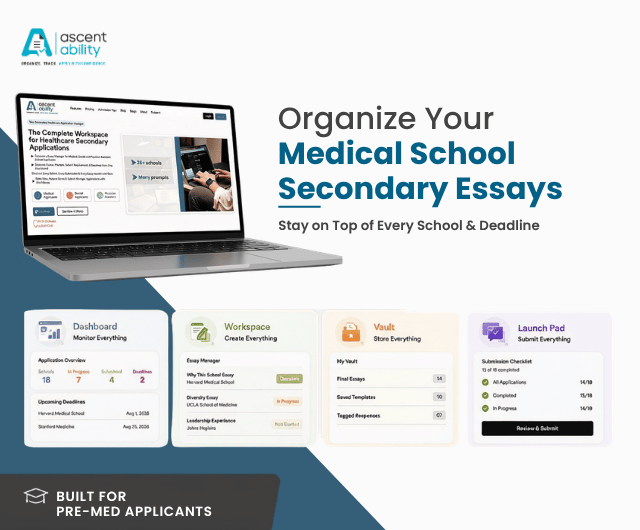
Dashboard - Track schools, deadlines, priorities, and progress at a glance. See which deadlines are imminent and which schools still need essays. Priority-rank schools so you draft your top choices first.
Workspace - Organize prompts, drafts, revisions, and school-specific essays in one place. Store all your versions and track improvements across multiple drafts.
Vault - Keep final essays and important application materials organized and secure. Store submitted materials so you can reference them if needed later.
LaunchPad - Review requirements and prepare completed applications for submission. Confirm you haven't missed anything before you submit.
With these tools, you'll spend less time hunting for deadlines and drafts, and more time actually writing strong essays.
Organize your dental school applications in one place
Key Takeaways
- Supplemental requirements vary by dental school; always verify each program's instructions.
- Answer the exact prompt before trying to impress the reader.
- Research the school before writing school-specific responses.
- Reuse experiences not identical essays.
- Track every prompt, deadline, requirement, and draft centrally.
- Use specific, truthful examples from your own experiences.
- Revise each response before submitting.
Conclusion
Supplemental essays feel like an afterthought after months of preparing your AADSAS primary application. But they're actually an important part of demonstrating fit.
Supplemental essays give you another opportunity to show that your application is thoughtful and school-specific. The most successful applicants treat supplementals not as last-minute additions, but as opportunities to strengthen their candidacy. They research each school thoroughly, tailor their essays to specific prompts, avoid the most common mistakes, and organize their work systematically.
You've already done the hard work of building a strong primary application. Now focus on making each supplemental response count.
Start organizing your secondary applications today. Track your prompts and deadlines. Draft with intention. Revise carefully. And move toward each submission with greater clarity and confidence.
Frequently Asked Questions
Q: How long should supplemental essays be?
A: Length varies by school and prompt. Follow the exact word or character limit provided by the program. If no limit is stated, check the school's instructions or contact admissions rather than assuming a standard length.
Q: Can I submit the same supplemental essay to multiple schools?
A: You can reuse relevant experiences or core ideas when prompts overlap, but each final response should directly answer that school's question and be personalized where school-specific fit is requested.
Q: When should I start writing supplementals?
A: Begin as soon as you receive the school's requirements and plan backward from its stated deadline. Don't wait until you've completed all schools' essays; start submitting completed essays as you finish them. This reduces pressure at the end of the cycle.
Q: Should I disclose a low grade or personal challenge in a supplemental essay if the school doesn't ask?
A: Follow the prompt. If the application provides an optional section for additional context, decide whether the information materially helps the school understand your record or circumstances.
Q: How do I personalize essays when I'm applying to multiple schools?
A: Research the school deeply. Reference specific program features, opportunities, values, faculty work, partnerships, or other details that genuinely connect to your goals. Generic praise isn't personalization.
Q: How many supplementals will I receive?
A: The number varies by the schools you designate and their individual application processes. Some schools require supplemental materials from all applicants, while others may request them selectively.
Q: What if I make a typo in a submitted essay?
A: If you discover a significant error after submitting, check the school's instructions and contact the admissions office to ask whether corrections are permitted. Policies vary by program.
Q: Should I use the same opening or closing for all my supplementals?
A: No. Each essay should feel tailored to that school. While you might use similar phrasing in multiple essays (e.g., multiple essays might start with an anecdote), the anecdotes should be different, and your conclusion should be specific to that school. Generic openings and closings make essays feel templated.
Related Dental Guides
Supplemental essays are one part of the larger dental school application process. Explore these related guides:
- How to Organize Dental School Applications in 2026: AADSAS, Essays & Deadlines - Step-by-step guide to managing the entire application timeline, from AADSAS submission through supplemental completion.
- Dental School Application Timeline 2026–27: AADSAS Dates, Deadlines & Checklist - Key dates, deadlines, and a downloadable checklist to keep you on track throughout application season.
- ADEA AADSAS Application Guide 2026-27: Requirements, Timeline & Step-by-Step Checklist - Complete walkthrough of the primary application process, AADSAS requirements, and submission steps.
OFFICIAL RESOURCES
- ADEA (American Dental Education Association): https://www.adea.org/ – Official dental education organization; resource for dental education trends and program information.
- ADEA AADSAS: https://www.adea.org/AADSAS/ - Official dental school application portal; deadlines, requirements, and submission guidelines.
- ADA (American Dental Association): https://www.ada.org/ - Professional organization with resources for prospective dentists; career information and educational standards.