Your healthcare Application journey starts here.


Blogs
How to Organize Medical School Secondary Essays for Multiple Schools (2026 Guide)


TL;DR Summary
Medical school secondary essays overwhelm applicants each school has different prompts and deadlines. The solution isn't writing faster; it's building a system. Learn to track prompts, categorize essay types, build a reusable library, and personalize every response. Whether applying to 10 or 30+ schools, this guide helps you stay organized, submit stronger essays, and reduce stress throughout the admissions cycle.
Introduction
Receiving your first batch of medical school secondary essays is exciting until you realize that every school has different prompts, different deadlines, and different expectations. Many applicants assume the biggest challenge is writing. But if you're applying broadly, you may receive dozens of school-specific essay prompts within a relatively short period.
The AAMC confirms that applicants can begin receiving secondary applications from schools around the primary-application process, and that these applications are school-specific. Without a clear workflow, it's easy to lose track of prompts, miss deadlines, or accidentally submit essays that don't fully answer what a school is asking.
Secondary application practices vary by medical school: some schools send them broadly, while others screen applicants before issuing an invitation.
Applicants who establish an organized process early can find it easier to manage multiple prompts, deadlines, and revisions without sacrificing writing quality.
While this guide focuses on medical school secondary essays, many of the same organization strategies can help Dental and Physician Assistant (PA) school applicants manage supplemental essays, deadlines, and application materials.
How Do You Organize Medical School Secondary Essays?
The most effective way to organize medical school secondary essays is to use a centralized system that tracks schools, prompts, deadlines, essay versions, and submission status. Group similar prompts, create an essay library, personalize every response, and review each application before submission.
Why Organization Matters More Than Speed
Many applicants believe they need to finish every secondary essay as quickly as possible. Speed certainly matters. However, organization matters even more.
A well-organized applicant can:
- Meet school deadlines consistently
- Personalize every essay appropriately
- Avoid repeating the same stories excessively
- Reduce last-minute stress
- Maintain higher writing quality
Medical schools evaluate your ability to communicate thoughtfully. Submitting rushed essays often weakens otherwise competitive applications.
Understand What Changes and What Stays the Same
One reason applicants become overwhelmed is because they treat every essay as completely unique. In reality, medical school secondary essay prompts often revolve around similar themes.
Common categories include:
- Why our medical school?
- Diversity and identity
- Adversity or challenge
- Leadership
- Service experiences
- Research
- Clinical exposure
- Gap year plans
- Future career goals
- Meaningful extracurricular activities
Although wording differs between schools, many prompts ask similar underlying questions. Recognizing these patterns makes organization significantly easier.
Applicants who want a deeper breakdown of common prompt types can read our Complete Guide to Medical School Secondary Essays (2026).
Step 1: Create a Secondary Essay Tracker
Your tracker becomes the command center for your entire application. A spreadsheet is a good starting point, but as the number of schools grows, many applicants prefer a dedicated essay management platform that keeps prompts, deadlines, essay versions, and progress in one centralized workspace.
Include columns such as:
| Column | Purpose |
| Medical School | Track every institution |
| Date Received | Know when secondaries arrive |
| Deadline | Prioritize submissions |
| Submission Status | Not Started, Drafting, Editing, Submitted |
| Prompt Category | Diversity, Leadership, Why Us, etc. |
| Word Count | Helps with planning |
| Final Submission Date | Track completed work |
| School-Specific Requirements | Track additional materials or instructions beyond the essay itself |
| Notes | School-specific reminders |
If you're using a spreadsheet, optional color coding can make status and urgency easier to scan for example, green for submitted, yellow for in progress, and red for urgent deadlines.
As your list of schools grows, a dedicated platform like AscentAbility can keep all of this information organized automatically, without manual color coding.
This simple system prevents overlooked essays and keeps your workload manageable.
Step 2: Group Similar Prompts Together
Instead of writing essays school by school, organize prompts by theme.
For example:
Leadership Essays
Draft your leadership story once. Then adapt it for each school's wording and character limit.
Diversity Essays
Keep your central message consistent while tailoring examples to each school's values.
Adversity Essays
Develop one comprehensive version before creating shorter or longer adaptations.
Grouping prompts reduces duplicated effort while maintaining quality.
Step 3: Build an Essay Library
Think of your essays as building blocks rather than finished products.
Create a folder containing polished stories about your experiences, including:
- Clinical volunteering
- Physician shadowing
- Research projects
- Leadership roles
- Community service
- Meaningful patient interactions
- Personal challenges
- Academic growth
Each story should include:
- Situation
- Actions
- Lessons learned
- Impact on your desire to become a physician
Your essay library should store reusable ideas and experiences - not copy-and-paste answers. Each final response should still address the exact school's prompt, word limit, mission, and context.
Rather than copying essays between schools, you'll adapt these stories to answer different prompts naturally.
Step 4: Reuse Ideas, Not Generic Answers
This is one of the biggest mistakes applicants make. Even if two schools ask nearly identical questions, each institution has its own mission, values, and priorities.
For example, instead of writing: “I want to attend your medical school because of your excellent education.”
Personalize your response by explaining:
- Specific curriculum features
- Clinical opportunities
- Community outreach programs
- Research strengths
- Geographic fit
- Student culture
Admissions committees quickly recognize generic essays. Thoughtful customization demonstrates genuine interest.
Step 5: Prioritize Deadlines Strategically
Not every secondary arrives at the same time.
Create three priority levels:
Highest Priority
- School-specific deadlines approaching
- Programs using rolling admissions or ongoing review
- Schools requesting completion within a particular timeframe
- High-interest programs
Medium Priority
Schools with moderate deadlines and flexible timelines.
Lower Priority
Schools received recently with later deadlines.
For schools using rolling admissions, completing your application earlier in the cycle may allow it to enter the review process sooner. Always follow the school's stated secondary deadline and instructions.
This approach prevents deadline bottlenecks.
For deadline planning, see our Medical School Secondary Essay Timeline (2026).
Still Managing Essays in Google docs?


Step 6: Set Weekly Writing Goals
Instead of focusing on your entire application, create manageable weekly targets.
For example:
- Monday - Outline two essays
- Tuesday - Complete first drafts
- Wednesday - Revise
- Thursday - Personalize school-specific content
- Friday - Final proofreading and submission
Small, consistent progress is more sustainable than marathon writing sessions.
Step 7: Avoid Essay Fatigue
Writing dozens of essays can reduce creativity over time.
Common signs include:
- Repeating identical wording
- Losing enthusiasm
- Forgetting prompt details
- Writing generic introductions
Combat fatigue by:
- Taking scheduled breaks
- Rotating prompt categories
- Writing during your most productive hours
- Reviewing successful essays for inspiration, not copying
Quality matters more than sheer volume.
💡 Expert Tip: Organize essays by theme rather than by school. This reduces duplicate work while making it easier to personalize each response.
How to Name and Organize Secondary Essay Versions
Clear file naming prevents you from ever wondering which draft is the one you actually submitted.
Use a consistent format such as: School_Prompt_Version
For example:
- Stanford_Diversity_v03
- Duke_WhyUs_v02
Keep your submitted version in a separate folder or clearly marked from your working drafts, so there's never any confusion about which essay was actually sent.
What Should You Do When a Secondary Application Arrives?
The AAMC advises applicants to stay on top of correspondence and notes that some schools send secondaries very quickly after verification. When a new secondary arrives:
- Record the school and date received.
- Confirm the school's deadline and instructions.
- Add every prompt to your tracker.
- Categorize each prompt.
- Identify reusable experiences from your essay library.
- Research the school before writing school-specific responses.
- Draft, review, and proofread.
- Record the final submission.
Common Mistakes When Organizing Medical School Essays
Avoid these frequent pitfalls:
Waiting Until Every Secondary Arrives
Begin organizing immediately.
Naming Files Poorly
Instead of: Essay Final Final V3 - Use: Stanford_Diversity_500Words_Final
Ignoring Rolling Admissions
For schools using rolling admissions, earlier, complete submissions may enter the review process sooner but always confirm each school's specific deadline and instructions rather than assuming.
Reusing Essays Without Editing
Every school deserves thoughtful customization.
Forgetting Version Control
Save previous drafts separately to avoid losing valuable edits.
A Sample Workflow for Managing Multiple Applications
An efficient workflow might look like this:
- Receive secondary invitation.
- Add school to your tracker.
- Categorize prompts.
- Search your essay library.
- Customize stories.
- Research school-specific details.
- Draft responses.
- Edit for clarity.
- Proofread carefully.
- Submit before the deadline.
- Mark the application complete.
Following the same process for every school reduces errors and builds momentum.
How AscentAbility Helps Applicants Stay Organized
At AscentAbility, we encourage applicants to think beyond simply answering prompts.
AscentAbility helps applicants with:
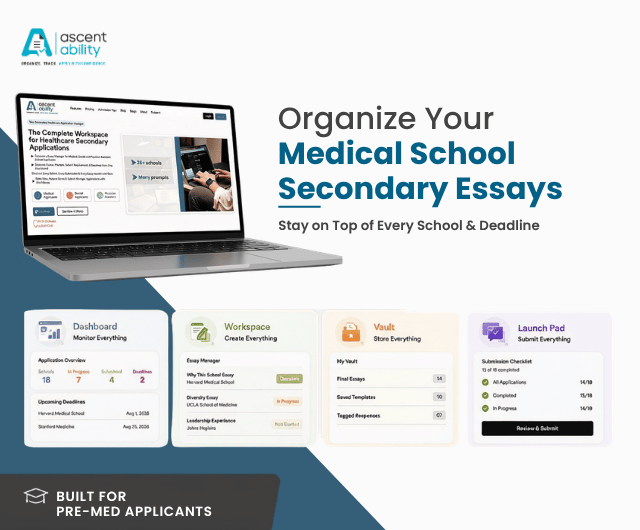
- Dashboard at a Glance
- Essay Workspace
- Application Vault
- Launch Pad
- School Management
- Deadline Tracking
- Essay Version History
- Progress Dashboard
- Prompt Organization
With everything organized in one centralized workspace, AscentAbility helps you spend less time managing applications and more time writing thoughtful, personalized secondary essays.
START FREE - With Your Medical School
Key Takeaways
- Create a centralized tracker.
- Group similar prompts.
- Build an essay library.
- Personalize every response.
- Prioritize deadlines.
- Save multiple versions.
- Review before submission.
A well-organized application process helps Medical, Dental, and Physician Assistant (PA) applicants save time, avoid mistakes, and submit thoughtful, personalized applications with confidence.
Conclusion
Organizing your medical school secondary essays isn't about finding shortcuts it's about creating a process that allows your strongest ideas to shine consistently across every application.
By using a centralized tracker, building an organized essay library, grouping similar prompts, researching schools in advance, and reviewing each submission carefully, you can manage multiple applications without sacrificing quality or authenticity.
The earlier you establish your system, the easier the secondary application season becomes. Thoughtful organization gives you more time to focus on what admissions committees value most: clear, personal, and compelling stories that demonstrate your readiness for medical school.
If you're preparing for this application cycle, start building your organization system today. Your future self and your application will thank you.
Frequently Asked Questions
1. How many medical school secondary essays should I expect to write?
The number varies considerably based on how many schools you apply to and how many prompts each school requires. Applicants applying broadly may need to manage dozens of individual essay responses, which is why organizing prompts by school and theme can be helpful.
2. When should I start preparing secondary essays?
Start preparing before secondary applications are released by reviewing past prompts and drafting responses for common essay themes. Early preparation helps you submit personalized, high-quality essays more efficiently.
3. What's the best way to keep track of multiple secondary essay deadlines?
Use a centralized tracker or application management platform to organize schools, prompts, deadlines, and submission status in one place.
4. Should I submit secondary essays in the order I receive them?
Not always. Prioritize essays based on rolling admissions, deadlines, and your top-choice schools while maintaining quality.
5. Can I organize applications without a spreadsheet?
Yes. While a spreadsheet works well initially, a dedicated application management platform can simplify tracking essays, deadlines, and application progress across multiple schools.
Related Resources
Continue building your secondary essay strategy by reading our other blogs:

.png)