Your healthcare Application journey starts here.


Blogs
Medical, Dental and Physician Assistant School Application Checklist: Complete Guide


TL;DR Summary
Successfully applying to medical, dental, or PA programs requires comprehensive planning covering school research, admission requirements, essays, recommendation letters, and deadline management while avoiding common mistakes. Most applicants navigate these pathways through AMCAS (MD programs), ADEA AADSAS (dental), or CASPA (PA programs). This guide serves as a complete checklist to keep you organized, ensure application completeness, and guide you confidently through your healthcare professional school journey.
Introduction
Applying to medical school, dental school, or a physician assistant (PA) program involves much more than meeting academic requirements. From researching programs and completing prerequisites to preparing application documents, writing personal statements and supplemental essays, and securing letters of recommendation, applicants must complete many important tasks throughout the admissions process.
Although each profession has its own application requirements and timelines, the overall journey follows a similar path. Staying organized helps you avoid missed requirements, incomplete applications, and other common mistakes that can affect your chances of admission.
This Medical, Dental & Physician Assistant School Application Checklist guides you through every stage of the admissions process. Whether you're applying for the first time or reapplying, you'll find practical steps to organize your materials, meet key milestones, and submit a stronger, more competitive application with confidence.
Before You Begin Your Medical, Dental & Physician Assistant (PA) School Application
Before you start completing applications, gather the essential information and documents you'll need throughout the admissions process. Preparing these materials in advance can help you stay organized, avoid last-minute stress, and complete your applications more efficiently.
Quick Start Checklist
- Finalized school list
- Updated resume or CV
- Official or unofficial transcripts
- Clinical, healthcare, volunteer, and research experience records
- Personal statement outline or draft
- Application timeline or calendar with important deadlines
What Is a Medical, Dental & Physician Assistant (PA) School Application Checklist?
A Medical, Dental & Physician Assistant (PA) School Application Checklist is a step-by-step guide that helps applicants organize every stage of the admissions process. It covers essential tasks such as researching programs, preparing required documents, writing personal statements and supplemental essays, requesting letters of recommendation, and tracking application deadlines. Using a checklist helps applicants stay organized, avoid missed requirements, and submit complete, competitive applications.
Instead of trying to remember multiple deadlines, documents, essays, and school-specific requirements, a checklist keeps everything organized in one place. It helps you complete important tasks on time, reduce last-minute stress, and avoid common application mistakes throughout the admissions cycle.
A comprehensive checklist should include:
- Researching schools and admission requirements
- Creating an application timeline
- Preparing required documents
- Writing your personal statement
- Completing supplemental or secondary essays
- Requesting letters of recommendation
- Tracking application deadlines
- Monitoring interview invitations and application progress
Although medical schools, dental schools, and Physician Assistant programs have different admissions requirements, following a structured checklist makes the entire application process easier to manage and improves your chances of submitting a complete application.
Why Following an Application Checklist Matters
Every application represents months or even years of preparation. Organizational mistakes can lead to missed requirements, rushed submissions, or application delays, even for otherwise strong applicants.
For example:
- A medical school applicant may delay completing secondary applications, which can slow application completion at schools that use rolling or ongoing review.
- A dental school applicant may overlook a program-specific prerequisite or supplemental requirement.
- A Physician Assistant applicant may fail to accurately document patient care hours or miss an important application deadline.
These mistakes are avoidable with proper planning and organization.
A structured application checklist helps you:
- Stay organized across multiple applications.
- Track deadlines for every school.
- Prepare documents well before submission.
- Monitor recommendation letters and transcripts.
- Keep essays organized and personalized.
- Reduce last-minute stress.
- Submit complete and competitive applications.
No matter which healthcare profession you're pursuing, organization is one of the most valuable tools for a successful application cycle.
Complete Medical, Dental & Physician Assistant (PA) School Application Checklist
Medical vs Dental vs Physician Assistant (PA) Applications: Which Application Service Do You Use?
| Pathway | Common Application Service | Important Note |
| Medical | AMCAS | Most U.S. MD schools use AMCAS |
| Dental | ADEA AADSAS | Most U.S. dental schools use AADSAS |
| Physician Assistant (PA) | CASPA | Many PA programs participate in CASPA |
Texas note: Texas residents applying to Texas dental schools use TMDSAS rather than ADEA AADSAS for those applications.
Every successful application follows the same foundation: careful planning, organized documentation, strong written materials, and timely submissions.
Use the checklist below as your roadmap throughout the application cycle.

Phase 1: Research Programs and Build Your School List
Reviewing these key criteria can help you identify programs that best align with your academic background, career goals, and personal preferences.
| Research Area | Medical School | Dental School | Physician Assistant Program |
| Curriculum | Traditional or integrated curriculum | Preclinical and clinical curriculum | Didactic and clinical curriculum |
| Clinical Training | Hospital and clinical rotations | Patient care and simulation clinics | Clinical rotations across specialties |
| Program Requirements | Review school-specific prerequisites, GPA, and admission requirements | Review school-specific prerequisites, shadowing expectations, and supplemental requirements | Review school-specific prerequisites and patient care hour requirements |
| Hands-on Experience | Clinical exposure; research opportunities may vary by school | Clinical exposure and shadowing expectations vary by program | Direct patient care experience requirements vary by program |
| Program Mission | Mission, values, and learning environment | Community outreach, patient care focus, and institutional values | Primary care focus, community health, and institutional mission |
| Program Outcomes | Residency match outcomes and graduate success | Licensure preparation and graduate outcomes | PANCE pass rates and graduate outcomes |
| Location & Cost | Tuition, location, and clinical opportunities | Tuition, location, and clinical opportunities | Tuition, location, and clinical rotation sites |
| Accreditation | Confirm accreditation status | Confirm accreditation status | Confirm accreditation status |
Your Research Checklist
- Build a balanced school list.
- Review school-specific admission requirements.
- Compare tuition and estimated living costs.
- Verify prerequisite coursework.
- Review admitted applicant profiles, where available.
- Save important admissions webpages for future reference.
Tip: Create a spreadsheet or use an application management platform to keep your school research organized from the beginning.
Phase 2: Understand Each Program's Admission Requirements
Although the overall application journey is similar, medical schools, dental schools, and physician assistant (PA) programs have different admissions processes and evaluation criteria. Reviewing each program's published requirements early can help you prepare a stronger application.
| Application Component | Medical School | Dental School | Physician Assistant Program |
| Prerequisite Coursework | Science and program-specific prerequisites vary by school | Science and program-specific prerequisites vary by school | Program-specific prerequisite coursework varies by program |
| Academic Profile | GPA expectations and prerequisite performance vary by program | GPA expectations and prerequisite performance vary by program | GPA expectations and prerequisite performance vary by program |
| Clinical or Healthcare Experience | Clinical exposure expectations vary by school | Shadowing and clinical experience expectations vary by program | Patient care experience requirements vary by program |
| Volunteer & Community Service | Importance varies by school | Importance varies by school | Importance varies by program |
| Research Experience | Importance varies by school and program | Importance varies by program | Importance varies by program |
| Personal Statement | Common application component; requirements vary | Common application component; requirements vary | Requirements vary by application service and program |
| Supplemental or Secondary Essays | Many schools request additional essays after the primary application | Some programs require supplemental essays | Some programs require supplemental essays |
| Letters of Recommendation | Requirements vary by school and may include faculty and healthcare professionals | Requirements vary by program and may include professors or dentists | Requirements vary by program and may include academic and healthcare professionals |
| Additional Requirements | School-specific prerequisites, experiences, or assessments may apply | Program-specific prerequisites or additional requirements may apply | Patient care hour requirements and other program-specific requirements may apply |
Important: Admission requirements differ by institution and application service. Always verify prerequisite coursework, experience requirements, essays, recommendation letter policies, and application deadlines on each program's official admissions website before applying.
Phase 3: Prepare Your Application Documents
One of the easiest ways to reduce application stress is by preparing your documents well before applications open.
Essential Documents Checklist
- Official transcripts
- Resume or Curriculum Vitae (CV)
- Personal statement
- Recommendation letter/evaluation requirements and recommender details
- Clinical experience records
- Volunteer experience
- Leadership activities
- Research experience (if applicable)
- Awards and achievements
- Certifications
- Professional licenses (if applicable)
Standardized Test Information
| Pathway | Common Testing Consideration |
| Medical | MCAT |
| Dental | DAT |
| Physician Assistant (PA) | Requirements vary by program |
For Medical, AMCAS is the centralized application service used by most U.S. medical schools. For Dental, ADEA AADSAS serves most U.S. dental schools, with the important Texas/TMDSAS exception. For Physician Assistant, CASPA enables applicants to apply to multiple participating Physician Assistant programs through one application.
Keeping these documents organized prevents last-minute searching and makes updates much easier throughout the application cycle.
Phase 4: Prepare Your Personal Statement and Essays
Your written application allows admissions committees to understand who you are beyond your academic achievements.
Whether you're applying to medical school, dental school, or a Physician Assistant program, your essays should demonstrate:
- Motivation for your chosen profession
- Meaningful experiences
- Personal growth
- Professional goals
- Commitment to patient care
Essay Preparation Checklist
- Brainstorm experiences before writing.
- Create an outline.
- Write your first draft early.
- Request feedback from mentors.
- Revise multiple times.
- Proofread carefully.
- Save different versions of your essays.
Secondary vs. Supplemental Applications
Although the terms are sometimes used interchangeably, they can refer to different application components depending on the profession and program.
- Medical School: Applicants commonly receive secondary applications after submitting their primary application. These typically include school-specific essay prompts and additional information requested by the institution.
- Dental School: Some programs require supplemental applications or materials, such as additional essays, forms, or program-specific documentation.
- PA Programs: Participating programs may request program-specific supplemental requirements, which can include additional essays, forms, or supporting documents.
Always review each program's official admissions website to understand its specific application requirements and terminology.
Although you can reuse ideas from previous essays, every response should be tailored to the individual program.
Example
❌ Generic Response
"I want to attend your program because it has an excellent reputation."
✅ Personalized Response
"I am particularly interested in your community-based clinical curriculum because it reflects my commitment to serving underserved populations through volunteer healthcare initiatives."
Generic responses may fail to demonstrate why a particular program is a strong fit for your goals and experiences. Taking time to personalize each essay helps communicate your genuine interest, thoughtful preparation, and alignment with each program's mission and values.
Phase 5: Request Strong Letters of Recommendation
Recommendation letters provide admissions committees with valuable insight into your academic abilities, professional potential, and personal character.
Choose individuals who know your work well and can provide specific examples of your strengths.
Potential recommenders may include:
- Professors
- Research mentors
- Supervisors
- Healthcare professionals
- Dentists
- Physicians
- Physician Assistants
- Volunteer coordinators
Important: Always review each program's specific letter of recommendation or evaluation requirements before selecting your recommenders. Requirements vary by institution and application service. For example, dental schools using ADEA AADSAS may have school-specific evaluation requirements, while medical schools and PA programs may have different expectations regarding the type and number of recommenders.
Recommendation Letter Checklist
Ask early.
- Provide enough time for writing.
- Share your resume and personal statement.
- Explain your career goals.
- Confirm each program's letter requirements.
- Track submission deadlines.
- Send thank-you messages after submission.
Strong recommendation letters often take several weeks to prepare, so request them well before application deadlines to give your recommenders sufficient time to write thoughtful, detailed evaluations.
Phase 6: Build Your Application Timeline
Creating a timeline helps prevent last-minute stress and keeps your application moving forward.
| Suggested Planning Timeline | Recommended Tasks |
| 12–18 Months | Research medical, dental, and PA programs, complete prerequisites, gain clinical or patient care experience. |
| 6–9 Months | Prepare your resume, request transcripts, begin your personal statement, and finalize your school list. |
| 3–6 Months | Request recommendation letters, revise essays, organize application documents, and review school-specific requirements. |
| Application Opens | Complete your primary application, upload required documents, and review every section carefully before submission. |
| After Submission | Complete supplemental or secondary applications, monitor application portals, and prepare for interviews. |
Starting early gives you more time to improve your application and reduces the risk of missing important deadlines.
Important: The timeline above is a general planning framework. Application opening dates, deadlines, and required materials vary by profession, application service (such as AMCAS, ADEA AADSAS, or CASPA), and individual program. Always confirm key dates and requirements on each program's official admissions website.
Phase 7: Complete Your Application and Review Everything
Submitting your application is one of the most important steps in the admissions process. Before clicking Submit, take time to carefully review every section. Small mistakes such as missing documents, incomplete experiences, or incorrect information can delay your application or require unnecessary corrections.
Whether you're applying to medical schools, dental schools, or physician assistant programs, a final review ensures that your application accurately reflects your qualifications and effort.
Final Submission Checklist
Before submitting your application, confirm that you have:
- Reviewed all personal and academic information.
- Confirmed required transcripts and supporting documents have been submitted or received according to the application service's instructions.
- Completed your personal statement.
- Tailored all supplemental or secondary essays for each school.
- Confirmed that letters of recommendation have been submitted.
- Verified prerequisite coursework.
- Reviewed your healthcare, volunteer, research, and leadership experiences.
- Double-checked application fees and payment confirmations.
- Saved copies of submitted applications.
- Confirmed every school-specific requirement has been completed.
Important: For Medical, AAMC explicitly warns that once AMCAS is submitted, changes are very limited, and errors can cause delays. A carefully reviewed application is far more valuable than a rushed application with avoidable errors.
Phase 8: Stay Organized After You Submit
Many applicants believe the application process ends after they click Submit, but the admissions journey continues throughout the application cycle.
Still Managing Essays in Google docs?


Medical schools, dental schools, and physician assistant programs may request additional information, supplemental materials, or interview scheduling after reviewing your application. Staying organized during this stage helps ensure you don't miss important updates or deadlines.
After Submission Checklist
- Monitor your application portals regularly.
- Check your email daily for admissions updates.
- Respond promptly to requests for additional information.
- Complete any remaining secondary or supplemental application requirements.
- Track interview invitations and scheduling.
- Prepare for interviews.
- Record admissions decisions.
- Update your application tracker throughout the admissions cycle.
Staying organized after submission helps you respond quickly to admissions requests, prepare for interviews, and keep track of your progress until final decisions are released.

Common Application Mistakes to Avoid
Even highly qualified applicants can make simple mistakes that affect their applications. Here are some of the most common issues and how to avoid them.
1. Starting Too Late
Many applicants underestimate the time required to prepare competitive applications.
Why it matters: Waiting until deadlines approach often leads to rushed essays, incomplete documentation, and missed opportunities.
What to do instead: Build your application timeline at least several months before applications open.
2. Applying Without Researching Programs
Not every program is the right fit for your goals.
- Medical applicants should compare curriculum styles and clinical opportunities.
- Dental applicants should review patient care experiences and clinical training.
- PA applicants should carefully evaluate patient care hour requirements and clinical rotations.
Researching programs helps you build a balanced and realistic school list.
3. Reusing the Same Essay for Every School
Admissions committees want to understand why you're interested in their program.
Submitting identical essays to every school can make your application feel generic.
Instead, reuse core experiences while tailoring every essay to each program's mission, values, and specific prompts.
4. Missing Important Deadlines
Application deadlines don't end after submitting your primary application.
Applicants also need to manage:
- Supplemental or secondary applications
- Recommendation letters
- Transcript submissions
- Interview scheduling
- Follow-up requests
Tracking deadlines in one place helps reduce the risk of missing important milestones.
5. Poor Document Organization
Searching through folders for transcripts, resumes, recommendation letters, or essay drafts wastes valuable time.
Create a centralized system for storing and updating all application materials throughout the admissions cycle.
6. Ignoring School-Specific Requirements
Every healthcare program has unique expectations.
For example:
- Some medical schools emphasize research and community service.
- Certain dental schools may request additional supplemental materials or specific prerequisite courses.
- Many physician assistant programs place significant weight on documented patient care experience.
Always review each program's official admissions website before submitting your application.
7. Not Proofreading Before Submission
Grammar mistakes, formatting issues, or incomplete answers can leave a poor impression.
Before submitting any application:
- Review every essay.
- Check spelling and grammar.
- Verify all experiences and dates.
- Ask a mentor or advisor to review your application.
A second review often catches mistakes you may have overlooked.
How AscentAbility Helps Medical, Dental & Physician Assistant Applicants
Managing applications for multiple medical, dental, or physician assistant programs can quickly become overwhelming, especially when you're tracking deadlines, essays, recommendation letters, and required documents across different schools.
AscentAbility simplifies the process with an all-in-one application management platform designed specifically for medical, dental, and PA applicants.
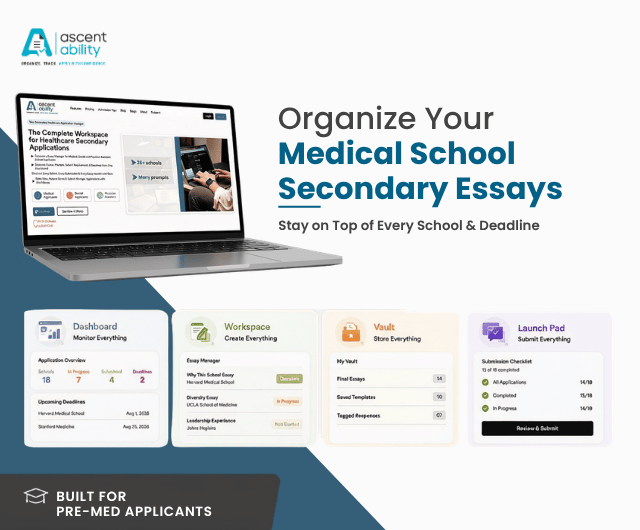
- Dashboard: Track schools, deadlines, application status, and overall progress from one place.
- Workspace: Organize personal statements, supplemental essays, drafts, and school-specific writing.
- Vault: Organize final essays, resumes, application materials, and other important documents.
- LaunchPad: Monitor school requirements, outstanding tasks, and submission progress to stay on schedule.
| Feature | Spreadsheet | AscentAbility |
| Track application deadlines | ✓ | ✓ |
| Organize personal statements & essays | Limited | ✓ |
| Store application documents | Limited | ✓ |
| Monitor application progress | Manual | ✓ |
| Manage multiple schools in one place | Limited | ✓ |
Whether you're applying to a few programs or managing multiple applications, AscentAbility helps you stay organized and focused throughout the admissions journey.
Key Takeaways
- Begin preparing your application months before deadlines.
- Research every medical, dental, or Physician Assistant program carefully.
- Organize all documents before applications open.
- Personalize every supplemental or secondary essay.
- Track recommendation letters and application deadlines.
- Review every application before submission.
- Continue monitoring applications after submission.
- Use a centralized system to manage your entire application journey.
Conclusion
Whether you're applying to medical school, dental school, or a physician assistant (PA) program, a structured application plan can help you stay organized, meet deadlines, and submit stronger applications. Use this checklist throughout your admissions journey and revisit it as you complete each milestone to ensure nothing is overlooked. Staying organized today can help you approach every stage of the admissions process with greater confidence.
No matter which healthcare profession you're pursuing, a well-organized process can help you submit more complete, accurate, and thoughtful applications while staying on top of deadlines and school-specific requirements.
Frequently Asked Questions
1. What is a Medical, Dental & Physician Assistant school application checklist?
A Medical, Dental & Physician Assistant school application checklist is a step-by-step guide that helps applicants organize documents, essays, recommendation letters, and deadlines for medical, dental, and Physician Assistant programs.
2. When should I start preparing my application?
Start preparing 12–18 months before applying to complete prerequisites, gain experience, and gather all required application materials on time.
3. What documents are usually required?
Most programs require official transcripts, a personal statement, letters of recommendation, a resume or CV, and records of clinical, volunteer, or healthcare experience.
4. What application service do medical, dental and Physician Assistant schools use?
Most U.S. MD programs use AMCAS, most U.S. dental programs use ADEA AADSAS, and many Physician Assistant programs participate in CASPA. Always verify the application service required by each program.
5. Do all healthcare programs require supplemental applications?
No. Supplemental or secondary application requirements vary by profession and individual program. Always check each school's admissions website for specific requirements.
6. What are the biggest application mistakes?
Common mistakes include starting late, missing deadlines, submitting generic essays, overlooking school-specific requirements, failing to proofread, and not tracking application progress.
7. How can I stay organized while applying to multiple schools?
Use a centralized application tracker or management platform to monitor deadlines, essays, documents, recommendation letters, and application status in one place.
8. What is the difference between AMCAS, AADSAS and CASPA?
AMCAS is used by most U.S. MD programs, ADEA AADSAS by most U.S. dental programs, and CASPA by many Physician Assistant programs. Each service has its own application process, requirements, and participating schools.
9. When should I request recommendation letters?
Request recommendation letters well before your planned submission date so recommenders have sufficient time to prepare thoughtful evaluations. Check each program's requirements and deadlines before making your requests.
Related Guides and Resources
Applying to medical school?
Start with our AMCAS Verification Timeline to understand the application process, then read our Medical School Secondary Essay Complete Guide to prepare stronger essays. Next, use How Many Medical Schools Should I Apply To? to build a balanced school list, and finish with our Medical School Secondary Essay Timeline (2026) to submit your secondaries at the optimal time for the best chance of receiving interview invitations.
Applying to dental school?
Read our ADEA AADSAS Application Guide (2026–2027) to understand the dental school application process, key dates, required materials, and how to prepare a stronger application.
Official Application Resources
For the most accurate and up-to-date admissions requirements, application policies, and deadlines, always refer to the official application services and professional organizations.
- AAMC — AMCAS: Official centralized application information for most U.S. MD programs.
- ADEA — ADEA AADSAS: Official application service information for most U.S. dental programs.
- PAEA — CASPA: Official centralized application service information for participating physician assistant (PA) programs.
Because admission requirements, deadlines, and application processes vary by profession and institution, always verify information directly through the relevant application service and each program's official admissions website before applying.

.png)